Anitoa Announces 3e-6 Lux Ultra Low-Light CMOS Bio-Optical Sensor

PR Web, Opli.net: Anitoa Systems, a Palo Alto startup established in 2011, announces what it calls the industry’s first 3e-6 lux ultra low-light CMOS Bio-optical Sensor and solution kit aimed to portable medical and scientific instruments. Anitoa’s single chip CMOS Bio-optical Sensor is capable of detecting 3e-6 lux narrow band light at 550nm with 20nm bandwidth with a better than 13dB SNR in the operating temperature between -25 to 85C, consuming only 30mW.

Anitoa sensor is a small, 5mm x 5mm, and said to be manufactured in mature 0.18um process by "a world-leader specialty foundry." The new compact sensor is expected to replace the bulky and expensive PMTs and cooled CCDs widely used today in molecular diagnostic instruments.

"Anitoa uses process optimization and novel circuit techniques to reduce the various noises of CMOS image sensor to achieve high signal-to-noise ratio. The excessive noise that cannot be eliminated in the chip, due to limitations of physics, is further computed and filtered through software algorithms that “understand” the statistical nature of different sources of noises and signals in the system," the company's whitepaper says.

Anitoa’s single-chip CMOS Bio-optical Sensor is available in the form of a “Solution Kit” for customer evaluation and early adoption. This Solution Kit includes Anitoa’s ULS 24 CMOS Bio-optical Sensor IC, an interface board, and integrated Intelligent Dark-current Management algorithm. The solution kit is priced at $1,500 each. Volume production of Anitoa’s ULS24 CMOS Bio-optical Sensor kit is estimated at 2Q15.

Anitoa executive team members have played leadership roles in well-known Silicon Valley IT and biotech companies such as Philips, ST Micro, Agilent, SST, Promega, Chiron, and Novartis. Anitoa partners with Zhejiang Nano-systems Institute (ZCNI), and the First Affiliated Hospital of Zhejiang University in China for clinical application validation and field deployment in that region.

Anitoa ULS24 imager
ULS24 parameters from opli.net article

Update: As noted in comments, Anitoa's whitepaper gives a table with different resolution, SNR and lux rating:

USL24 parameters from Anitoa's whitepaper

Qualcomm Acquires Dutch Vision Software Startup

Startup Juncture reports that Qualcomm has acquired Amsterdam, Netherlands-based image and video recognition startup Euvision Technologies. The deal is rumored to be in the range of tens of millions of euros. Euvision was founded in 2010 as a spin-off from University of Amsterdam. Euvision software is capable of recognizing faces, license plates and can identify ID cards, checks, Excel sheets, sunsets, beaches, etc.

A Vimeo video shows the company's pitch:


Thanks to BVB for the info!

Sharp 3D Motion Sensor

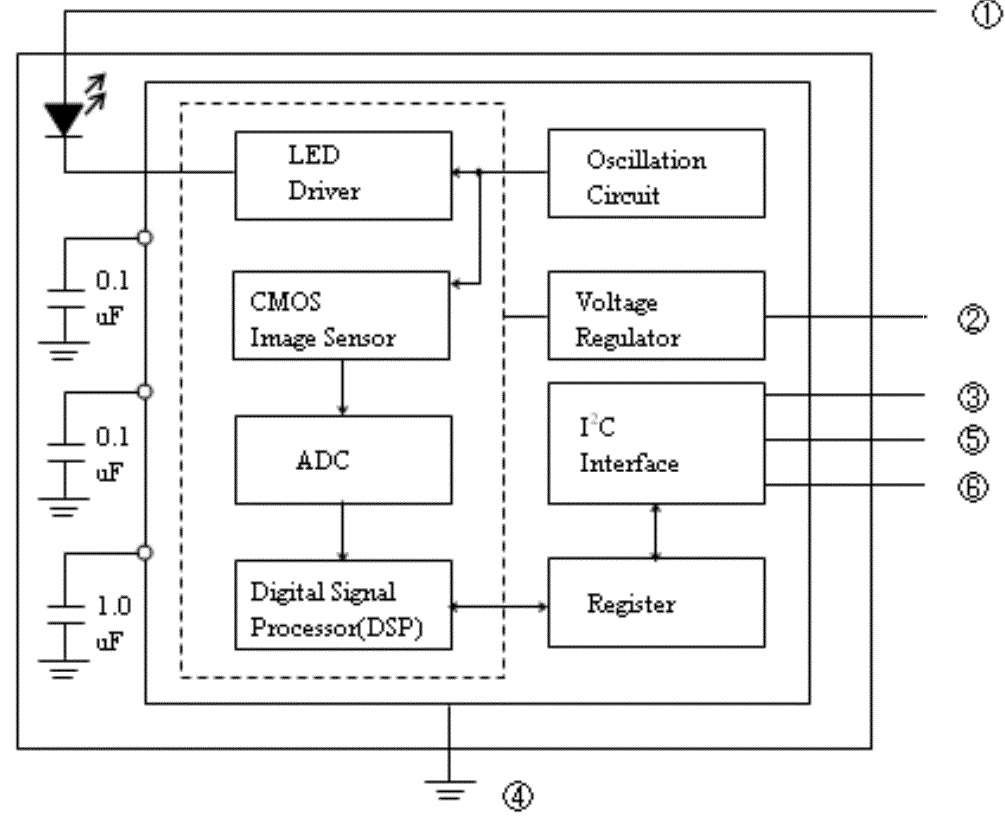
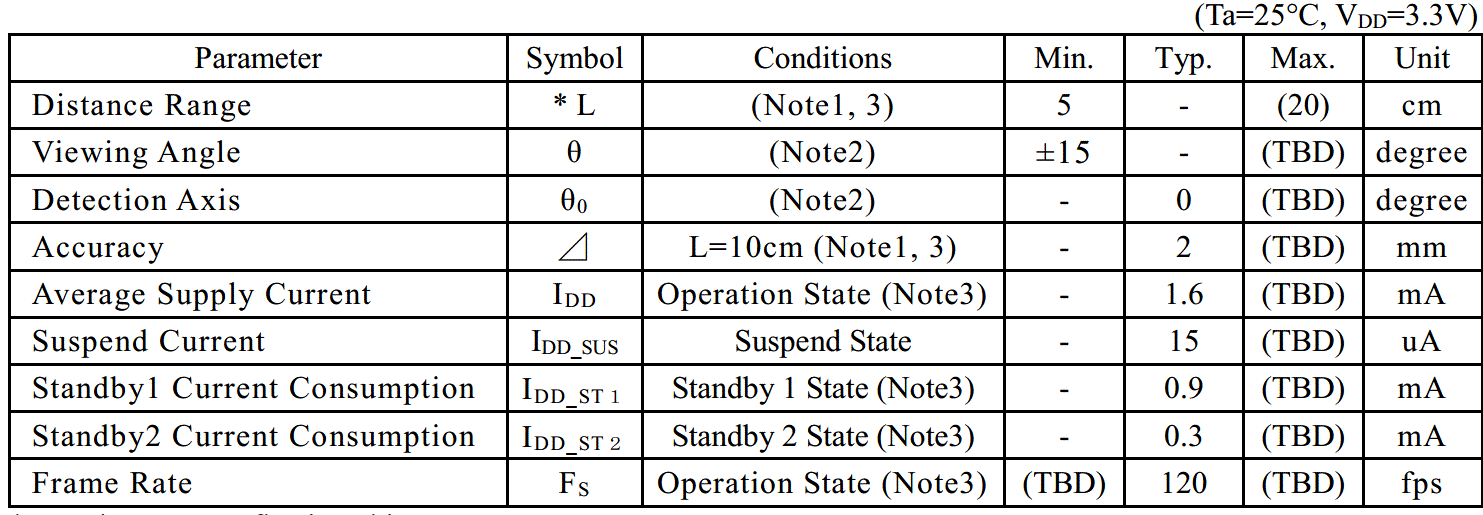
Sharp has announced its GP2Y8E01 3D motion sensor almost a year ago, but, apparently, only in Japanese. The sensor uses LED and 30x30 pixel image sensor integrated in a single module:


For those who can read Japanese, EETimes-Japan explains how it works.

Etesian Offers CIS Production Management at TowerJazz

Business Wire: TowerJazz enhances its customer support through a partnership with Etesian Semiconductor, a provider of ‘boutique’ foundry program management services for products with low to medium volume production. The collaboration offers TowerJazz’s customers the option of using Etesian as program and supply chain manager throughout various stages of design/prototyping, yield analysis, and production. The engagement will focus on the European market and will include projects using all the various process technologies TowerJazz offers, starting with CMOS image sensor applications.

"Etesian employees are very familiar with TowerJazz processes and are located near our Migdal Haemek facility which enables them to react fast," said Avi Strum, TowerJazz’s VP and GM, CMOS Image Sensors Business Unit and VP Sales, Europe. "By utilizing the Etesian team's capabilities and support model, our customers benefit from additional foundry services beyond wafers such as test, packaging, and special starting material."

"With the recent years’ growth of TowerJazz and its superb foundry technology offerings, we are enhancing the support to the customers for the high complexity projects through our ‘boutique’ support model," said Etesian’s Founder and CEO, Elie Toledano.

One notable example of Etesian customer is Anafocus.

Criticism is Welcome

I got an unusual request from Dario Clocchiatti, a fresh graduate from Università degli Studi di Udine, Italy. After reading critical responses on many theses posted in this blog, Dario would like to present his MS degree thesis for a review. The thesis work has been done over a period of six months in CMOSIS, under Guy Meynants supervision.

The thesis "Characterization of Single Pixels in CMOS Image Sensors" is available for download at Google Drive. It covers a wide range of information, starting from various pixel operation aspects, all the way to the electrical measurements (optical characterization is not covered) and even PPD device simulations. Some figures from the thesis:

ON Semi Announces 8.6MP APS-H CCD

Business Wire: ON Semiconductor announces 8.6MP APS-H format CCD aimed to industrial imaging applications. The KAI-08670 TRUESENSE CCD has 7.4um pixel size and is available in monochrome, Bayer Color and TRUESENSE Sparse Color Filter Pattern configurations.

"Many applications, such as those found in industrial inspection, intelligent traffic and surveillance markets, can’t compromise on imaging quality," said Chris McNiffe, VP, Image Sensor Business unit at ON Semiconductor. "The KAI-08670 Image Sensor extends the superior performance of our 7.4 micron CCD family to a new resolution node, expanding options for customers who require this advanced level of imaging performance."

As always, Truesense releases all significant performance parameters with no NDAs:


Engineering Grade devices are available today, with full production planned by the end of the year.

Particle Imaging at CERN

ISSCC publishes an interesting video of 2014 Plenary Talk by Erik Heijne on particle imaging "How Chips Pave the Road to the Higgs Particle and the Attoworld Beyond" (requires Microsoft Silverlight). Few slides from the presentation:


And here is a Vimeo link to the presentation. Thanks to DSSB for the link!