Omnivision Proposes Hard Mask in CFA Manufacturing

Omnivision's patent application US20140210028 "Color filter including clear pixel and hard mask" by Gang Chen, Duli Mao, Hsin-Chih Tai, and Howard Rhodes proposes hard mask process to improve CFA etching accuracy:

"With pixel size scaling down, design rules for color filters should follow the trend and allow the color filters to be scaled down as well, but due to specific processing features of the color filters the scaling is challenging and painful. Introducing new materials is a common approach for improving color filter scaling, but light transmission, process controllability, yield, delivery, and overall optical performance could be sacrificed."


"Clear filter 106 and color filters 108, 110 and 112 are formed on surface 103 of optional planarization layer 104. A first hard mask layer 114 and a second hard mask layer 116 are formed over clear filter 105 and color filter material 107, while only second hard mask layer 116 is formed over color filter material 109. In the illustrated embodiment no hard mask layer is formed over color filter material 111, but in other embodiments an additional clear layer can be formed over filter material 111 and second hard mask layer 116. Hard mask layers 114 and 116 are clear (i.e., substantially colorless) and optically transparent in a range of wavelengths that includes at least the wavelengths of the color filters. In the illustrated embodiment, one or both of hard mask layers 114 and 116 can be made of the same clear material as clear filter 106. In one embodiment hard mask layers 114 and 116 are oxide layers, but in other embodiments other materials can be used provided they meet optical performance and manufacturing requirements. By using oxides or other materials with good light transmission properties, the “old” low cost, mature, optimized color filter materials can extend their application to pixels of any size, the only limit being patterning resolution, which is smaller than the shortest wavelength of the visible light."

Sound from 60fps Video

MIT News: MIT, Microsoft and Adobe team presents SIGRAPH 2014 paper describing a way to extract sound from an object micro-vibrations in the video stream: "The Visual Microphone: Passive Recovery of Sound from Video" by Abe Davis, Michael Rubinstein, Neal Wadhwa, Gautham Mysore, Frédo Durand, and William Freeman. While similar techniques based on laser and high speed cameras has been known for a long time, the MIT team manages to get the sound using a regular 60fps DSLR video stream. A Youtube video explains their approach:


Thanks to TG for the link!

Slanted Edge Method Improvements

Albert Theuwissen publishes a next post in "How to Measure MTF" series. This one talks about the improvements of slanted edge approach by means of column oversampling.

e2v to Acquire Anafocus for up to 34.2M Euros

RTT News, Business Weekly, Optics.org, Electronics Weekly: e2v is to acquire Seville, Spain-based Innovaciones Microelectronicas SL, also known as AnaFocus for up to 34.2M euros.

The initial cash purchase price of 29.2M euros is made up of 26.5M euros cash consideration for the business, and assumed net debt of 2.7M euros. The AnaFocus management team is staying with the business and can achieve an earn-out of up to 5M euros in cash, dependent on value generating 'stretch' integration targets including revenue growth. In 2013, AnaFocus had revenues of 5.6M euros and EBITA of €80,000. In the calendar year to December 31, 2014 AnaFocus is expected to generate sales of approximately €11M.

e2v technologies’ Group CEO, Steve Blair, said: "AnaFocus adds technology, people and customers to our machine vision business. It strengthens our position in the market, bringing to e2v a successful management team with deep technology capabilities and close relationships with customers that complement e2v’s relationships. The strength of the AnaFocus team, and the e2v worldwide sales and customer support channels they can now access, will help us to accelerate our opportunities in this fast-growing business. We see immediate opportunities to apply the technical capabilities of AnaFocus to provide enhanced offerings to our joint customers. I am delighted we are making this acquisition and I am pleased the AnaFocus team are joining us."

e2v expects the acquisition to complete during September 2014. AnaFocus will become an integral part of the machine vision business within e2v’s High Performance Imaging division, which grew by 26% last year. Both e2v and Anafocus use TowerJazz as their sole foundry partner for CMOS image sensors.

Aptina Completes CFA Fab Acquisition

Business Wire: Aptina has completed the purchase of CFA processing and imager probe assets from Micron. Following the purchase, Aptina will operate a fabrication facility in Nampa, Idaho that employs nearly 100 employees who will work closely with Aptina’s existing pixel optics research and development team. In addition, Aptina will hire management, development and support roles to bring its Idaho presence to approximately 250 total employees.

Sony Reports CMOS Sensor Sales Growth, Updates Yearly Targets

Sony posts its quarterly results and reports a significant image sensor sales increase and a camera module production launch:


Sony also has updated its semiconductor business flyer, increasing FY2014 image sensor sales target to 390B yen, up from 360B yen in the previous flyer from 2 months ago. The CMOS sensor production capacity increased from 60M units per month to 75M units, and the planned capital investment in image sensors rises from 450B to 500B yen:

Samsung Files for Lightfield Imager Patent

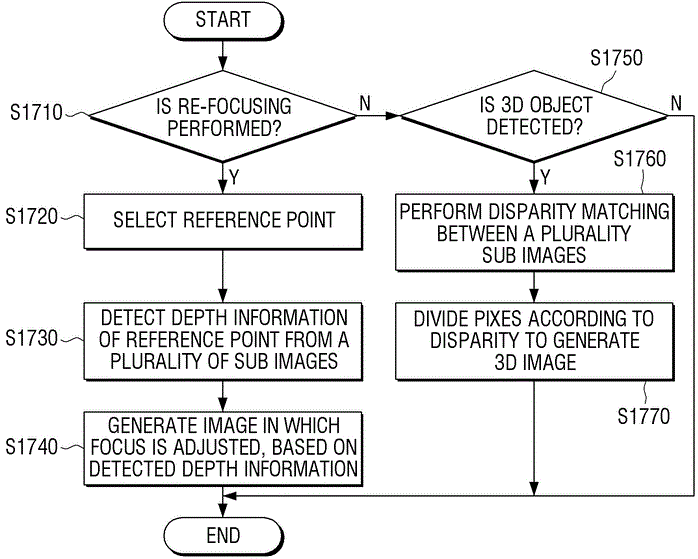
Samsung patent application US20140204183 "Photographing device and photographing method for taking picture by using a plurality of microlenses" by Tae-Hee Lee, Stepan Tuliakov, Hee-chul Han proposes to move color filter in front of big microlenses in order to avoid demosaicing blur in each sub-image: